Tess van der Ark
Atelier De Rökker
DIE dichters
Vanda Bednaříková
Nelleke Bosland en Saskia Koster
Ger Dekkers
Jonathan Doorduin
Roland Farkaš
Sep Friesema
Gideon van Gameren
Poal en de Bennies
Pip Greenaway
Tara Haghi
Sietse Henselmans
Kalliopi Ioumpa
Thomas van Poppel
Laith al Rahmani
Yunji Song
Lea van Vlodrop
Emma Wijnsma
The texts below have been translated from Dutch using Google Translate.
Tess van der Ark – Waiting Room
Tess van der Ark works with installations in which disruption, doubt, and confusion take center stage. She investigates how people react to social systems and everyday rules, and creates situations in which the familiar is questioned in an absurd manner. In her project *Wachtkamer* (Waiting Room) , she literally places visitors in a situation of discomfort: they take a number and enter a waiting room that references a village doctor’s consulting room. Within this space, visitors encounter recognizable elements such as instruction leaflets, but these have been subtly disrupted and rendered absurd.
The work invites reflection on how everyday rituals and expectations steer behavior and produce discomfort. Van der Ark does not name a norm, but sketches situations in which the audience actively experiences how social conventions and systems function and disrupt. By temporarily relocating Wachtkamer to a truck in the village square, she transforms a public space into an experimental lab for absurdist interaction, inviting the audience to become aware of the subtle tensions and rules of conduct that structure our daily lives.
Tess van Ark Website: https://tessvanderark.nl/
Atelier De Rökker
The following can be seen at care farm De Rökker:
- Art Brut – Work from the studio of De Rökker
- Paintings by Gideon van Gameren
- Sculptures by Roland Farkaš
Website of Atelier De Rökker: https://www.derokker.nl/
DIE dichters – Words in the Garden
At Pentecost, poems and songs resound at one of the most beautiful spots along the KunstenLandschapRoute: the secluded garden of Landgoed Het Amelink, De Amelinckshof. The DIE Dichters — Poets in Enschede — read aloud, sing, and conjure words into the air, surrounded by greenery and silence.
DIE is the literary engine of Enschede. The group organizes poetic activities in the city throughout the year, from lunch concerts at the Muziekcentrum to poetry festivals during Museum Night. They also played a key role in the creation of the annual city poet election and published a commemorative anthology this year in honor of Enschede’s 700th anniversary. In short: a group that knows how to turn words into a celebration.
Poets in Enschede (DIE) makes itself heard with poetry and
songs. The word as a weapon, a caress, and a balm for the soul. Listen to whispered poems, landscape reflections, song poems, and poems of solace.
THOSE poets are: Ernst Bergboer, Jos Eertink, Bram Geerlings,
Regine Hilhorst, S. van Tuinen, Margót Veldhuizen, Moes Wagenaar, Arthur Adam ten Cate, Wouter Munsterman, Rineke Kuiper and junior poet Stella Kensah
Enjoy poems and songs, have a cup of coffee or a refreshing drink at De Amelinckshof, sample the treats — and let yourself be surprised by the hidden beauty of this enclosed garden. This year, KunstenLandschap winds from the village of Lonneker through the Twente landscape to the Roombeek district, passing more than 20 artworks in places where nature and art complement each other. The Amelink is one of the most beautiful stops along the way.
In good weather, the garden becomes a true paradise. But honestly: with the DIE Dichters, it is always pleasant to be indoors or outdoors.
Het Amelink Estate · 11:00–17:00
Website of DIE dichters: https://dichtersinenschede.nl/
Vanda Bednaříková – Ants
In her sculptural installations, Vanda Bednaříková works with the tension between physical presence and intrusion: who or what becomes the intruder in a space—the enormous ceramic body or the visitor entering the space? Her work reflects collective feelings of uncertainty and anticipation in unpredictable times and makes the invisible tangible: the uncomfortable dynamics of coexistence, the silence of absence, and the tension of expectation.
In her practice, Bednaříková explores the relationship between humans, the environment, and materials. She works with clay, reclaimed objects, and remnants of structures, often inspired by natural, parasitic structures such as termite mounds. Large, sloping ceramic sculptures dominate her installations as ambiguous monuments: simultaneously host and threat, protection and threat. Sound and silence are integrated to enhance the sensory experience.
Her recent work focuses on experimental glazing techniques, in which thin layers retain the rawness and traces of the making process. In this way, the sculpture becomes a “second skin” that both protects and reveals, emphasizing the duality of strength and vulnerability, concealment and revelation. Visitors are invited to participate actively, navigate their own experiences, and explore the relationship between material, memory, and transformation.
Website Vanda Bednaříková: https://www.vandabednarikova.com/
Nelleke Bosland and Saskia Koster – The urinal wrapped
At Galerie Trafo-3, the details of the building itself form the starting point. The artists use the immediate surroundings—from the fuse box and the steel window frames to the sidewalk in front of the door—to build a new world. As a result, the boundary between the brick reality and their own constructions blurs.
Saskia Koster responds to the dynamics of the city. She uses residual materials from demolished buildings to create precise new structures. Load-bearing lines are central to her work; they function as supporting pillars, comparable to the construction of scaffolding. Together, these raw materials form structures with a character all their own.
Nelleke Bosland plays with the existing architecture. With moving light projections and tightly stretched tape, she transforms the walls into abstract spaces. Through the use of rhythmic lines and reflections, a kind of optical illusion is created, making you momentarily doubt whether what you see is real or if you are looking at a digital world.
At Galerie Urinoir BEZET, the styles of Nelleke Bosland and Saskia Koster merge into an overwhelming Gesamtkunstwerk. Using pallets and shrink wrap, they transform the familiar form of the urinal into a new object in public space. With a nod to the artist Christo, this work pays homage to a community that embraces and cherishes art.
As a visitor, you stand before a building that has lost its form; the urinal looks like a precious object or a visual disturbance in reality. Through the taut skin of foil and layers of transparent tape, you look into a vibrating, intense depth. The installation functions as a passive battery: it captures daylight and transforms it into an unreal glow that causes the small building to swell from within. Even without electricity, the raw constructions and refined lines merge into a tangible dream world that changes character every hour — from a fierce explosion in the full sun to a mysteriously glowing lantern at twilight.
Nelleke Bosrand Website: www.nellekebosland.nl
Website Saskia Koster: www.saskiakoster.com
Ger Dekkers – Abstractions of the Landscape
Ger Dekkers (1929–2020) is regarded as a pioneer of landscape photography in the Netherlands. He once wrote about his work: ‘My true subject is the influence of our culture on the landscape.’ According to him, the Dutch landscapes with polders, dikes, and planted rows of trees were a striking example of this. In his photo series, he reveals the clean lines and patterns of the man-made land. Dekkers’ work aligns with developments in the contemporary visual arts of the day, such as abstract geometric, conceptual, Land Art, serial, photo sequence, and fundamental. Yet, he clearly follows his own path.
Conceptual art, which was sweeping in from America at that time, landed on fertile ground with Dekkers. Later, he would focus on newly reclaimed land where human habitation was still absent, but where the hand of man was clearly recognizable in the clean lines of dikes and ditches.
Dekkers himself called his work landscape observations. He chose a viewpoint, determined the frame, and captured the landscape in series. Each image is slightly different because Dekkers, for example, took a step to the left or to the right. The identical horizons and repetitions emphasize the artificial, straight lines of the fields, ditches, and trenches.
Dekkers grew up in Twente and studied from 1950 to 1954 at the then newly established AKI art academy in Enschede. After graduating as a graphic designer, he started his own design studio, for which he also did a great deal of photography. In addition to his documentary photography, Dekkers focused on autonomous work from the late 1960s onwards, in which he increasingly abstracted the Dutch landscape. The work of Ger Dekkers is included in the collections of the Stedelijk Museum Amsterdam, the Kröller-Müller Museum, and the Nederlands Fotomuseum, among others.
Jonathan Doorduin – Greedy Henry
Greedy Hendrik is an interactive 30-minute film installation in which film, 3D objects, and theater come together to create an immersive total experience. Here, we step into 19th-century Twente, where a life-sized loom comes to life at unexpected moments and a physical door provides access to a mysterious merchant.
In the story, we follow Hendrik and Griet, who cultivate flax in the summer from which they weave fabrics in the winter. After a brief introduction to the traditional flax process, the atmosphere changes. With the rise of the textile industry, starvation looms, until a tempting offer changes everything. What begins as a fairy tale evolves into a dark saga about greed, tradition, and freedom of choice.
The installation establishes a subtle link between past and present, with themes such as overproduction within the (fast) fashion industry. Through interactive elements, the audience becomes part of this unique experience, which is intriguing and memorable both in terms of content and visuals.
Greedy Henry originated from a Cross-Tic project; after the opening in Oyfo (2024), it has not been on display in its entirety in this region.
Website Jonathan Doorduin: https://jonathandoorduin.com/
Roland Farkaš – Sculptures
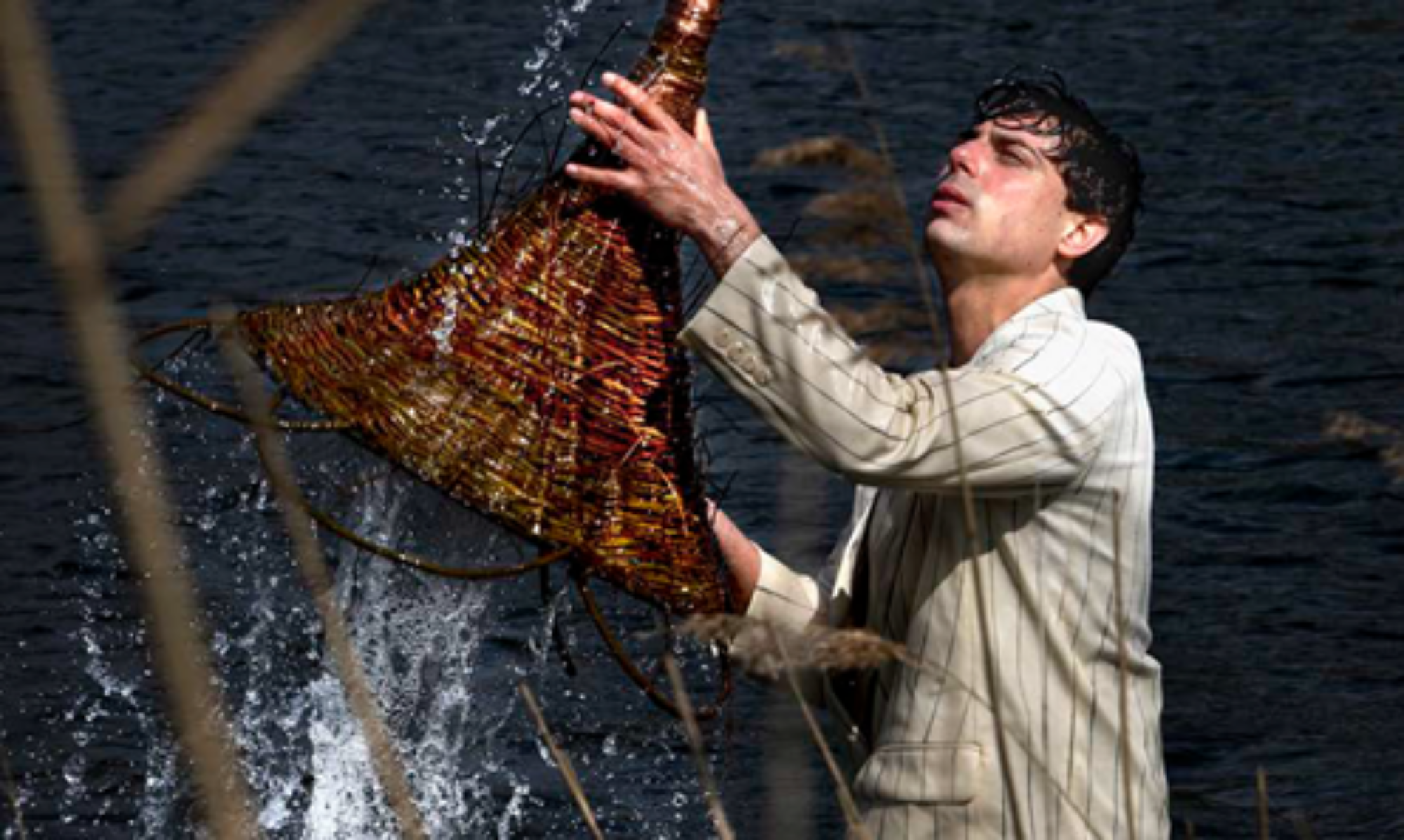
Roland Farkaš grew up in Slovakia; he has both Hungarian and Roma roots. In his work, he explores the stories and materials from his childhood, in which the legacy of his father is always palpable—his father was a basket weaver, and from him Farkaš learned this ancient technique.
Willow branches, copper, and textiles are the starting point for Farkaš. In the process, a form of communication emerges between him and these ‘charged’ materials; he enters into a dialogue with them. This intuitive approach leads to drawings,
sculptures and, more recently, performances. In doing so, he seeks new stories and a different kind of language, one that we understand with our bodies rather than with our minds.
In this orchard, he presents a selection of existing works and creates a new sculpture in three days, in dialogue with the landscape.
Facebook Roland Farkaš: www.facebook.com/farkas.x
Sep Friesema – Walking in Orgaan Sund
Sep Friesema graduated from the Bachelor of Moving Image at AKI ArtEZ Academy of Art & Design. In her graduation film, she explores the boundary between man and nature, demonstrating that these concepts cannot be strictly separated. Through a combination of real nature footage, editing, sound design, and performance, Friesema creates new, surreal places that feel familiar yet simultaneously somewhat unsettling.
Within KunstenLandschap, Friesema presents her work in the historic tea house “Sprakel in het Bos”. The building, which was requisitioned by the Germans for military purposes during World War II and subsequently repurposed, provides a context that reinforces the theme of her film – the relationship between history, nature, and human presence. Her work invites the public to reflect on the interplay between man and nature and offers a new perspective on familiar environments.
Friesema’s film is an invitation to experience beauty, discomfort, and wonder, and thus fits within the profile of KunstenLandschap as a route for investigative, context-specific visual art.
Website Sep Friesema: https://sfadoresyou.com/
Gideon van Gameren – Paintings
Gideon van Gameren (1998) graduated from the AKI ArtEZ Academy of Art & Design in Enschede in 2025. He creates large, colorful paintings that appear abstract at first glance. His expressive, smoothly applied broad brushstrokes and splatters reveal a speed of action, as if momentum could slip away from him at any moment.
On closer inspection, you discern figurative elements between the color planes. Through the titles of the works, Van Gameren reveals a little more about what inspired him. He recreates scenes from his parents’ workshop. In this workshop, located next to the family home, campers are repaired and rented out. By taking the work as a starting point, he explores the relationship between himself and his family, but also the relationship between domesticity and work.
Anyone who grew up with a home-based business knows what that means: the work never stops. The domestic atmosphere and the working atmosphere often merge. But the paintings in this series are devoid of drama. With precise lines, Van Gameren depicts a bent-over figure in the work ‘Welding Helmet’, hidden behind a welding helmet. The yellow-white rays of light released during the welding process stand out like a razor-sharp cross against the dark background.
In ‘Achterbak’ (2025), Van Gameren also uses contrasting colors. Jets spraying upwards suggest an unforeseen moment during the repair. Not without humor is the large work ‘De teen van mijn vader’ (2024). Against a light background, a leg sticks up into the air in an absurd manner, with a foot prominently in view. Above it are two large fingers, making the whole seem to offer a distorted perspective. With this, Van Gameren captures a family trait: when his father has to calculate and align something in his head, he looks at his big toe with one eye.
Gideon van Gameren Website: https://gideonvangamerenkunst.cargo.site/
Poal and the Bennies – stories and music from the heart of Twente
There are performances that stick with you. Not because they are grand, but because they are so relatable. Poal en de Bennies is one of them.
Paul Abels — writer, publisher, and columnist for the daily newspaper Tubantia, where he writes the column ‘Korte Metten’ twice a week about everyday situations and memories in a lighthearted, Twente style — takes the stage with a treasure chest full of stories. More often than not, those stories are about death, love, the past, and growing up in Lonneker. How one should live. What else should one write about?
Paul was born and raised in Lonneker, and you can hear it. His Twente roots resonate in every story. His romantic yet distinctly Twente outlook on life is central to his sometimes intense narratives, told in precise, vivid language. He loves the homeless and mavericks, individualists with a good story.
Standing by his side is Bennie Waanders. Bennie provides beautiful music on saxophones and keyboards. But he joins the conversation too. On the saxophone, he reinforces the stories, sometimes he picks up the guitar — always just enough, never too much.
Profound stories about life and the past, but also convivial anecdotes. Everything is drenched in a Kannogwa sauce: the relaxed zest for life.
Humorous. Moving. True to life.
Poal en de Bennies is a performance for people who love real stories, music that speaks, and a venue where you laugh together and fall silent for a moment.
And even more beautiful to see in the Roman Catholic Church of St. James the Greater, opposite Paul’s birthplace. Whit Sunday and Whit Monday in the afternoon at 2:00 PM.
Pip Greenaway – Prologue
Prologue presents a slowed-down, 112-minute recording of a figure compulsively chewing gum while water flows over her face. This performance embodies the transformation of the human being into an unwanted byproduct of consumption: first desired, then discarded. With its compelling use of aesthetics, sound, and lighting, the work depicts an absurd yet serious question about our identity in a world of overstimulation.
Pip Greenaway, a graduate of the Royal Academy of Art (KABK), has been named the winner of the Lakeside Collection Award 2025. She was selected from 26 promising artists nominated by the Ron Mandos Young Blood Foundation for Best of Graduates 2025. The jury praised her ability to tell a layered story about overconsumption and the search for independence within a capitalist system.
“Prologue” is part of the installation “Too much to swallow”.
Pip Greenaway website: https://pipgreenaway.com/
Tara Haghi – Paintings
Tara Haghi (IR/NL) is an Iranian-born visual artist, trained at AKI ArtEZ, with an investigative painting practice in which she employs the everyday urban landscape as a means for alienation and shifting meaning. Her work starts from recognizable Dutch streets and buildings, often situated in Enschede, but extracts them from their functional and geographical context.
Through the conscious use of color, light, and perspective, Haghi transforms these environments into ambiguous spaces where reality and imagination coincide. The paintings function as mental landscapes that reflect on themes such as identity, home, and cultural displacement. In doing so, her work aligns with current societal and artistic issues surrounding migration and positioning within contemporary visual art.
Haghi’s practice is characterized by a consistent visual language and a clear artistic development within contemporary figurative painting. Her increasing exhibition practice, both regionally and nationally, underscores her potential and relevance as a visual artist.
Website Tara Hachi: https://taranest.com
Sietse Henselmans – Holly Glen
Sietse Henselmans presents a sculptural installation in which everyday architecture and social interaction take center stage. KunstenLandschap places his complete kitchen in the middle of the Lonnekeres, beneath an imposing, ancient oak tree in an open, bare landscape. By placing this intimate, familiar interior space in a public and empty outdoor environment, a poetic tension arises between inside and outside, proximity and distance, private and community.
The kitchen functions as a place of encounter and contemplation. The work explores how recognizable spaces steer social rituals and behavior, and how their meaning changes when the context is disrupted. By literally removing the kitchen from its usual environment, Henselmans invites the public to re-experience familiar routines, material culture, and interaction, and to reflect on the role of everyday objects in our lives.
At location 4, Sietse Henselmans shows a video about the Holly Glen installation.
Sietse Henselmans Website: https://sietsehenselmans.cargo.site/
Kalliopi Ioumpa – The Color of Void
Kalliopi Ioumpa is an artist and scientific researcher. In her multimedia installation The Color of Void, Ioumpa explores how reality is constantly constructed, deconstructed, and reshaped.
The central point of the work is the ruin of a house, a living archive that functions both as a symbol and as a place for memory. Memory and imagination intertwine into ‘ghosts’ that shape the experience in the here and now.
Through this interplay, the installation addresses the cyclical nature of beginning and end and reflects on how the emergence of the new is inextricably linked to the letting go of the old, viewing transition as a continuous, layered process.
Absence leaves traces; the stones of the ruin, fragile glassware, video, audio, and scent create a total experience that attempts to follow these traces.
Kalliopi Ioumpa website: https://kalliopiioumpa.com
Thomas van Poppel – Solus
Through my work, I explore what seems to be increasingly lost: silence, the spiritual, and the tangible. I attempt to rediscover and redefine reality, and to reveal a world present beneath the noise. With light, photography, video, and sound, I create immersive environments that invite confrontation and contemplation, offering space for reflection and a renewed connection with the intuitive and poetic aspects of existence.
Thomas van Poppel Website: https://thomasvanpoppel.com/
Laith Al Rahmani – Inhabiting Discomfort
Laith Al Rahmani works with ceramics as a carrier of identity and personal experience. As a queer artist from the Middle East, he uses this material to explore anxieties, alienation, and vulnerability. His kinetic installation Inhabiting Discomfort consists of carefully crafted ceramic plates and forms a meditative, rhythmic space where sound, movement, and balance converge. Visitors are invited to surrender to the work and simultaneously experience tension and trust: the whole moves and resonates, yet remains stable, a metaphor for vulnerability and resilience.
The presentation in an old stable at the foot of the Lonnekerberg reinforces the dialogue between the raw, robust character of the space and the delicate, precise ceramic forms. Through these contrasts, an intense physical and sensory experience is created that emphasizes the poetic and tactile quality of Al Rahmani’s work.
Laith Al Rahmani website: https://laithrahmani.com/
Yunji Song – Sounds Like Home
In Sounds Like Home , Yunji Song explores the themes of home, memory, and displacement through sound and image. The work stems from her experience of living in sixteen different houses, each move prompted by gentrification and redevelopment. The continuous moving mirrors the instability brought about by financial uncertainty and the inaccessibility of permanent housing.
Sounds like home focuses on five former homes, each translated into a sound piece that attempts to retain their unique sonic identity amidst continuous change.
As architecture loses ‘its’ people, residents lose their habits, relationships, and a sense of connection to a place. Although many of these houses have already been demolished, the work captures the remnants of spaces that no longer exist through spatial audio tracks, etched graphic scores, photographs, and monotypes.
Yunji Song website: https://yunjisong.info/
Lea van Vlodrop – Language, signs and symbols
Lea van Vlodrop’s work is shaped by her interest in language, signs, and symbols.
Her paintings and painted objects emphasize the invisible connection between the personal and the universal that is present in everything, and build bridges between the conscious and the unconscious. Fascinated by the power of symbols to encompass diverse meanings—such as thoughts, ideas, prohibitions, rules, myths, secrets, or narratives—she employs this potential in her work to question how we relate to what is seemingly easy to dissect through our eyes.
Lea van Vlodrop Website: https://www.leavanvlodrop.com/
Emma Wijnsma – How much can you carry?
How much can you carry?
Worldwide, there is enough clothing for six generations, yet we keep buying. In this work, I make that tangible with a mechanism that allows me to put on all my clothes one by one. In photos and video, the pile grows into a heavy, almost comical burden.
The installation invites us to pause, without guilt but with awareness, to reflect on our purchasing behavior and to appreciate what we already possess.
Instagram Emma Wijnsma: https://www.instagram.com/studiodilemma/